Parlay

Overview
Parlay is an AI-powered conversational commerce platform designed to help customers discover products through natural language interactions instead of relying on traditional search and filtering.
Rather than navigating large product catalogs, users describe what they are looking for, ask follow-up questions, compare options, and receive personalized recommendations through an intuitive conversational interface.
As UI Director and Product Design Lead, I focused on simplifying AI interactions while ensuring the experience remained transparent, trustworthy, and aligned with familiar ecommerce behaviors — while also managing the design team's timelines and coordinating with stakeholders, developers, and our logo agency to keep the project on track.
Parlay demonstrates my ability to design emerging AI experiences that feel intuitive, trustworthy, and user-centered — and to lead the team and process behind that work. Beyond translating complex conversational AI capabilities into familiar shopping interactions, I directed UI standards across the design team, owned end-to-end product decisions, and managed timelines and budget across designers, developers, and an external branding agency. The project highlights both my design thinking and my ability to lead a cross-functional team toward a shared product vision.
Key Services Provided
Role: UI Director & Product Design Lead
I held two roles on Parlay. As UI Director, I led the UI design and personally shaped key product design decisions, setting the visual and interaction standards that other designers followed throughout the project. As Product Design Lead, my scope extended end-to-end . Owning UX and UI direction, coordinating with stakeholders, developers, and the external agency responsible for the logo, and managing designers' timelines and workload to keep the project on budget and on schedule.
The Challenge
Traditional ecommerce experiences often rely on filters, search bars, and large product grids that require users to already know what they are looking for.
The challenge was to design an AI shopping experience that felt natural and conversational while still giving users confidence in the recommendations they received.
The interface also needed to balance conversational interactions with traditional ecommerce behaviors such as browsing products, reviewing details, comparing options, and making purchasing decisions.
Because conversational AI was still an emerging interaction model, establishing clear expectations, maintaining transparency, and reducing uncertainty became critical design challenges.
Beyond the design problem itself, the project required coordinating a multi-disciplinary team — designers, developers, and an external branding agency — within a defined budget and timeline.
Goals
User Goals
- Discover products through natural conversations.
- Receive relevant personalized recommendations.
- Compare products with confidence.
- Reduce the effort required to find the right product.
- Build trust in AI-generated recommendations.
Business Goals
- Increase product discovery.
- Improve recommendation relevance.
- Reduce friction throughout the shopping journey.
- Encourage customer engagement.
- Create a scalable conversational commerce framework.
- Deliver the project on time and within budget while maintaining design quality across a distributed team.
Product Design Approach
The project focused on designing conversations rather than interfaces.
Working closely with stakeholders and developers, I translated AI capabilities into guided user journeys that felt familiar while introducing a new way of interacting with ecommerce platforms.
Instead of replacing traditional shopping experiences, conversational interactions were integrated into existing browsing behaviors, allowing customers to move seamlessly between AI recommendations, product exploration, and purchasing decisions.
Throughout implementation, I collaborated directly with developers, reviewed UX decisions, and ensured consistency across every touchpoint.
A Spatial Structure for a Conversational Product
Rather than organizing the platform around typical ecommerce navigation, the experience was structured around three spaces that mirror how a customer moves through a physical store: the Showroom, where customers browse curated products visually — the familiar, low-effort part of shopping; the Lobby, a transitional space where browsing gives way to conversation; and the Negotiation Room, where the AI takes over as a conversational partner — answering questions, comparing options, and helping the customer settle on the right offer.
This spatial metaphor extended into the color system itself: teal represents open, visual browsing in the Showroom, navy represents the focused, one-on-one conversation of the Negotiation Room, and the Lobby blends the two — giving the interface a color logic that reinforces where the customer is in their journey, even though the entire experience is digital and largely conversational.
Giving the AI experience a sense of place helped solve one of the project's core challenges: because conversational AI was still an emerging interaction model, customers needed a way to intuitively understand where they were and what to expect next, without that guidance being spelled out in instructional copy.
Validation and Iteration
The MVP was tested with 15 participants in Canada. Testing identified three major areas of friction: AI search relevance, filtering flexibility, and negotiation transparency.
The findings were particularly valuable because they challenged parts of the initial experience.
33%
of participants encountered irrelevant or incomplete AI search results.
20%
wanted stronger filtering options
47%
wanted clearer pricing information before entering negotiation.
Project Solutions
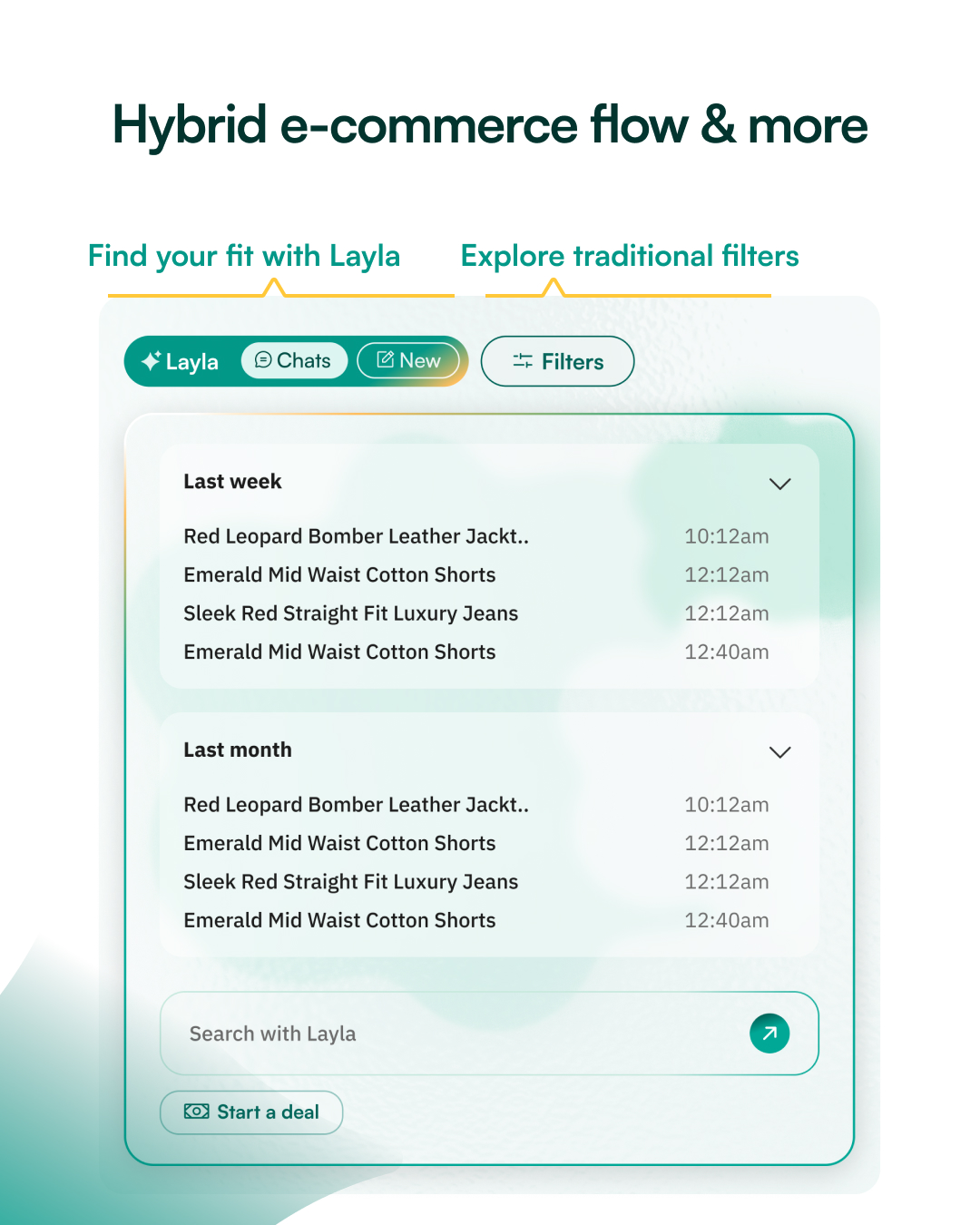
We designed a hybrid shopping experience where AI assistance and familiar e-commerce patterns work together rather than forcing users into a chat-only journey.
AI-powered product discovery
Layla allows users to search conversationally, refine requests over time, discover alternatives, and compare products. The research showed that users expected AI to understand context, ask clarifying questions, and help compare prices, reviews, specifications, and fit—not simply return more products.
- Conversational Product Discovery - Designed an AI-powered conversation flow that helps users discover products by describing their needs in natural language rather than relying solely on filters or keyword searches.
- Transparent AI Recommendations - Created recommendation experiences that explain suggested products through relevant attributes and contextual information, helping users understand why specific items were recommended and increasing confidence in AI-assisted decisions.
- Hybrid Shopping Experience - Balanced conversational interactions with familiar ecommerce patterns, allowing users to switch effortlessly between AI conversations, product browsing, comparison, and detailed product pages.
- Scalable Interaction Framework -Established reusable conversation patterns and interface components that support different retail scenarios while maintaining consistency across the platform.
- Enterprise Design System - Applied reusable UI components and interaction standards that allowed the conversational experience to scale alongside the broader product ecosystem.
- Cross-Functional Collaboration - Worked closely with developers and stakeholders throughout implementation to validate interactions, refine workflows, and ensure a high-quality user experience.
Outcomes
The project established a scalable conversational commerce experience that demonstrates how AI can simplify product discovery without replacing familiar ecommerce behaviors.
By combining conversational interactions with traditional shopping patterns, the platform helps users discover products more naturally while maintaining trust and transparency throughout the experience.
The reusable interaction framework also provides a foundation for expanding conversational AI capabilities across future retail experiences.
Project Impact
15 MVP test participants
The MVP was tested with 15 participants in Canada using Maze, covering AI product search, negotiation, and checkout.
67% interested in AI negotiation
The testing report shows that 10 of 15 participants said they would definitely negotiate if given the opportunity. This is a strong validation of the core concept because negotiation was one of Parlay’s main differentiators.
80% showed purchase potential
This is probably your strongest number because it connects the experience to purchase intent without pretending that actual conversion occurred.



Related Work



Let’s Talk