hiperPersonalization - Expresia

Overview
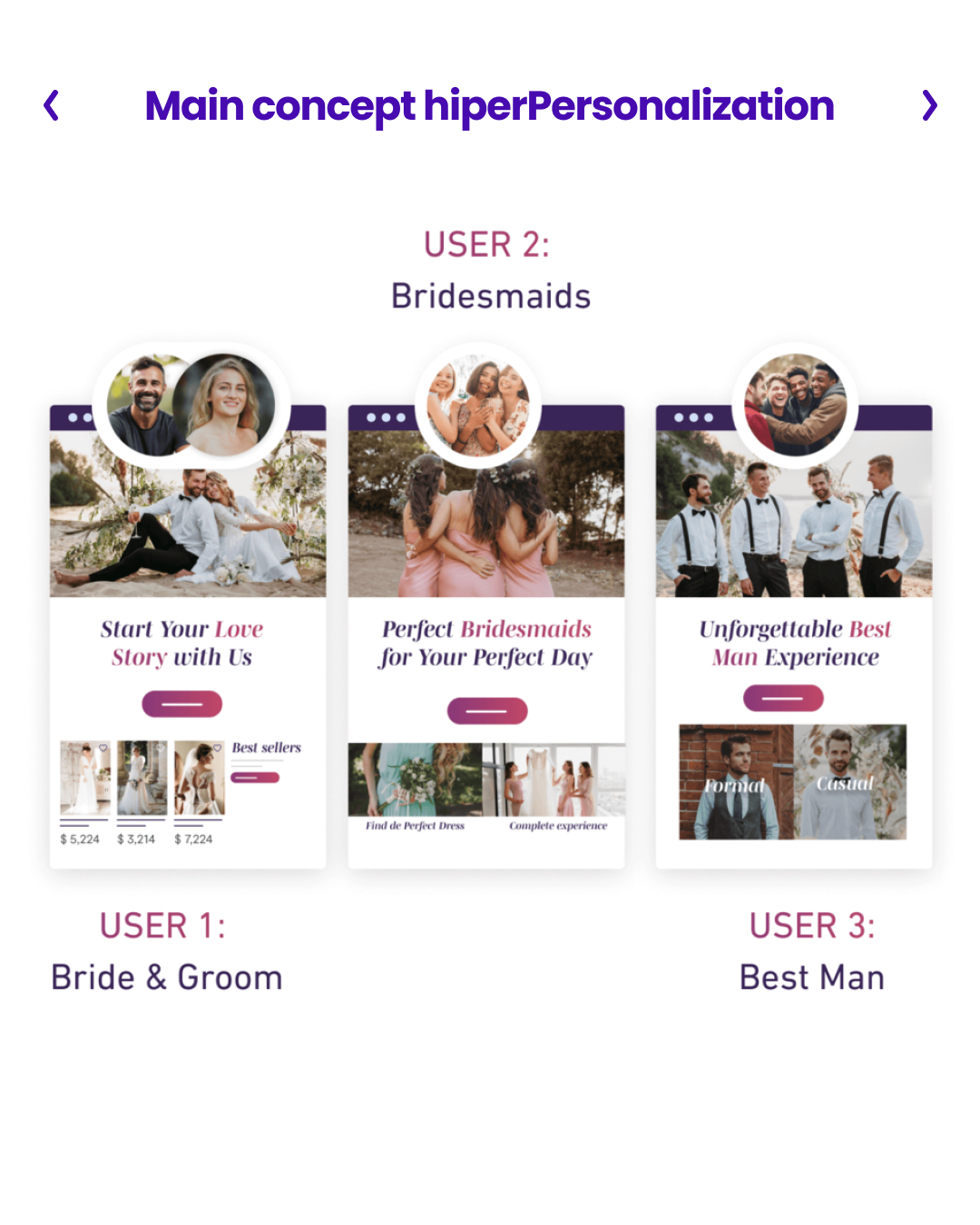
Most websites show every visitor the same thing. Hyperpersonalization exists to change that — it lets a business create different experiences for different types of visitors, without manually rebuilding the site for each one.
Here's how it works in simple terms: the system looks at how people behave on a website — what they click, read, and engage with — and groups visitors into audiences based on shared interests or patterns. Once those audiences exist, a business can decide what content or experience each audience should see. Expresia describes this as a continuous loop: analytics inform audiences, audiences inform personalization, and personalization creates new behavior to analyze — so the system keeps learning rather than being set once and forgotten.
The product was first built and tested inside Teck's digital ecosystem, which gave us a genuinely complex real-world environment to design against, while building the platform to scale to other Expresia clients beyond Teck.
Key Services & Role
Role: Lead UI Designer
I was the main lead designer on hyperPersonalization, working hand-in-hand with the Lead UX Designer and the Product Owner from early concept through delivery. While I owned the visual and UI direction, this wasn't a project where UX handed off flows for me to style ,the product's complexity meant UX and UI decisions were tangled together, and I was actively involved in solving usability problems, not just designing around them.
A lot of my time went into helping simplify how the product's many moving parts — audiences, rules, recommendations, experiments — fit together into something a non-technical content or marketing user could actually understand and trust. I translated that complexity into interface patterns that could scale across different clients, workflows, and levels of technical comfort.
- Product Strategy — Translating business goals and complex technical capabilities into product features and clear user workflows.
- UX/UI Problem-Solving — Working alongside UX to simplify complex workflows, not just style them.
- Information Architecture — Defining how Analytics, Audiences, and Personalization & Experiments connected across the product.
- Design System — Creating reusable patterns and components that could support different clients, data structures, and future features.
- Prototyping & Validation — Testing workflows with stakeholders and refining the experience alongside the development team.
- Developer Collaboration
- Design QA
My role was to make a technically complex system understandable and usable for the people actually managing digital experiences — and to do that by working through the hard usability questions with UX, not just visualizing their answers.
Challenge
Most analytics tools are good at telling you what already happened — pageviews, bounce rates, conversions. But that data usually lives separately from the tools teams use to actually act on it, like content management or personalization systems. Expresia saw the opportunity to connect those pieces into one product.
The real challenge wasn't just technical — it was making something powerful genuinely usable. The system needed to let teams:
- See how different audiences behave
- Understand what those behaviors mean
- Act — deciding what content each audience should see
- Measure whether that decision actually worked
Without asking users to understand how the AI or data works behind the scenes. And because the product would be used by different organizations, it also needed to work with different audiences, content, and ways of working.
Goals
User goals
- Understand audiences more clearly — see how different groups behave and what they're interested in
- Move from data to action — turn behavioral insight into a content or personalization decision
- Manage personalization with confidence — use AI recommendations without losing editorial control
- Test and improve experiences — compare personalized experiences and measure what's working
Business goals
- Build a reusable personalization product, not a one-off Teck feature
- Connect the full workflow — analytics, audience intelligence, and personalization — into one experience
- Make AI understandable to non-technical users
- Support different business contexts, audiences, and content strategies
Product Design Approach
I worked closely with the Lead UX Designer to approach the product as a connected decision-making system, rather than a set of separate dashboards bolted together. Every screen needed to answer: what does this help someone decide or do next?
The core experience follows a simple progression:
Behavior → Insight → Audience → Personalization → Measurement
This became the backbone of the product architecture, organized around three connected areas: Analytics, Audiences, and Personalization & Experiments. The intent was for a user to move naturally from understanding what's happening on their site, to identifying who's behind that behavior, to deciding how the experience should respond to them.
What a user can actually do:
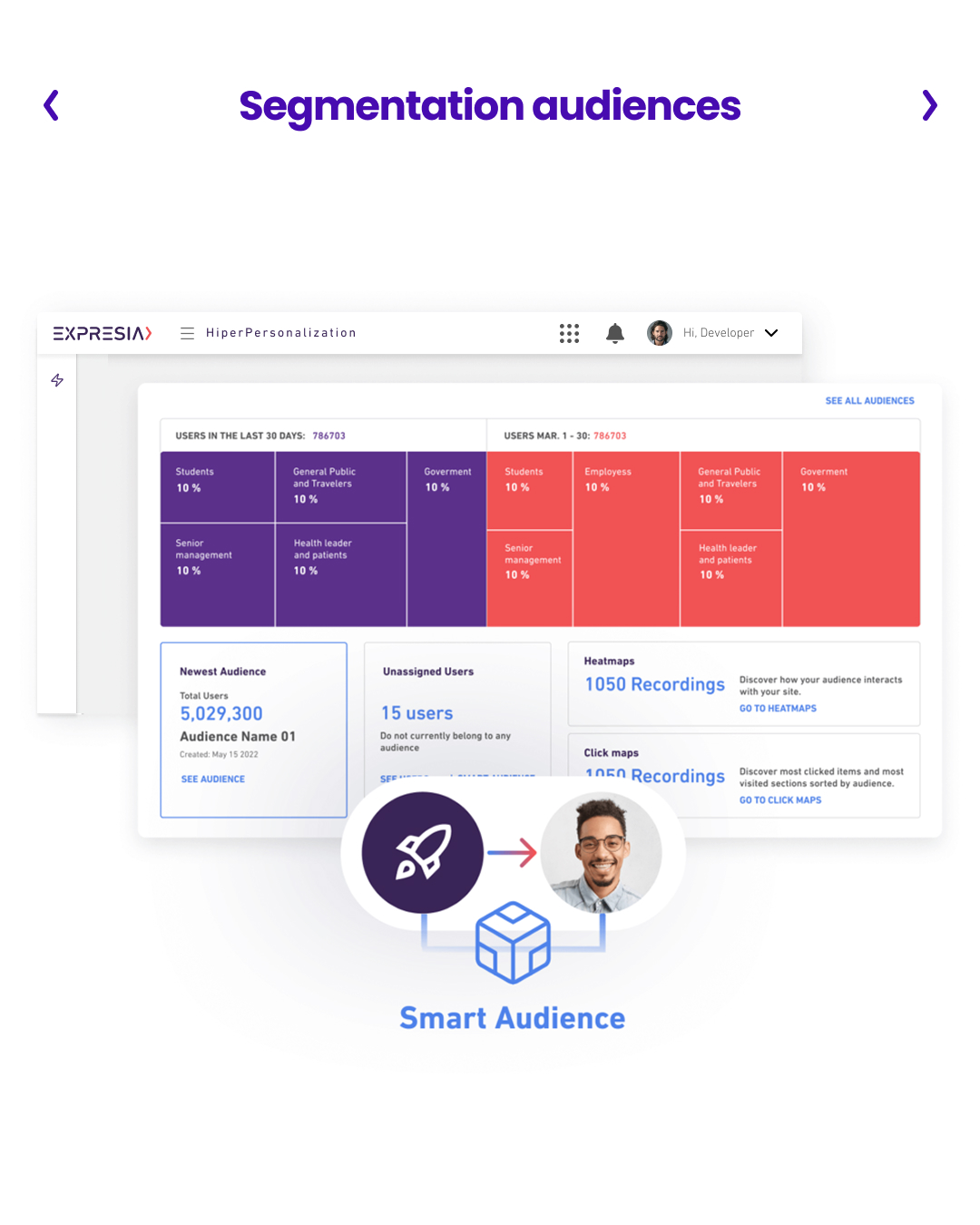
- Create audiences — either manually, or let AI group users automatically based on behavior and content interests
- Define audiences using multiple signals — content preferences, behavioral patterns, and even UTM data from ad campaigns, so paid traffic and organic behavior feed the same system
- Decide what each audience sees using Smart Playlists — dynamically assembled content collections that respond to an audience's interests, with a slots system that lets a real person pin, reorder, or override the AI's suggestions
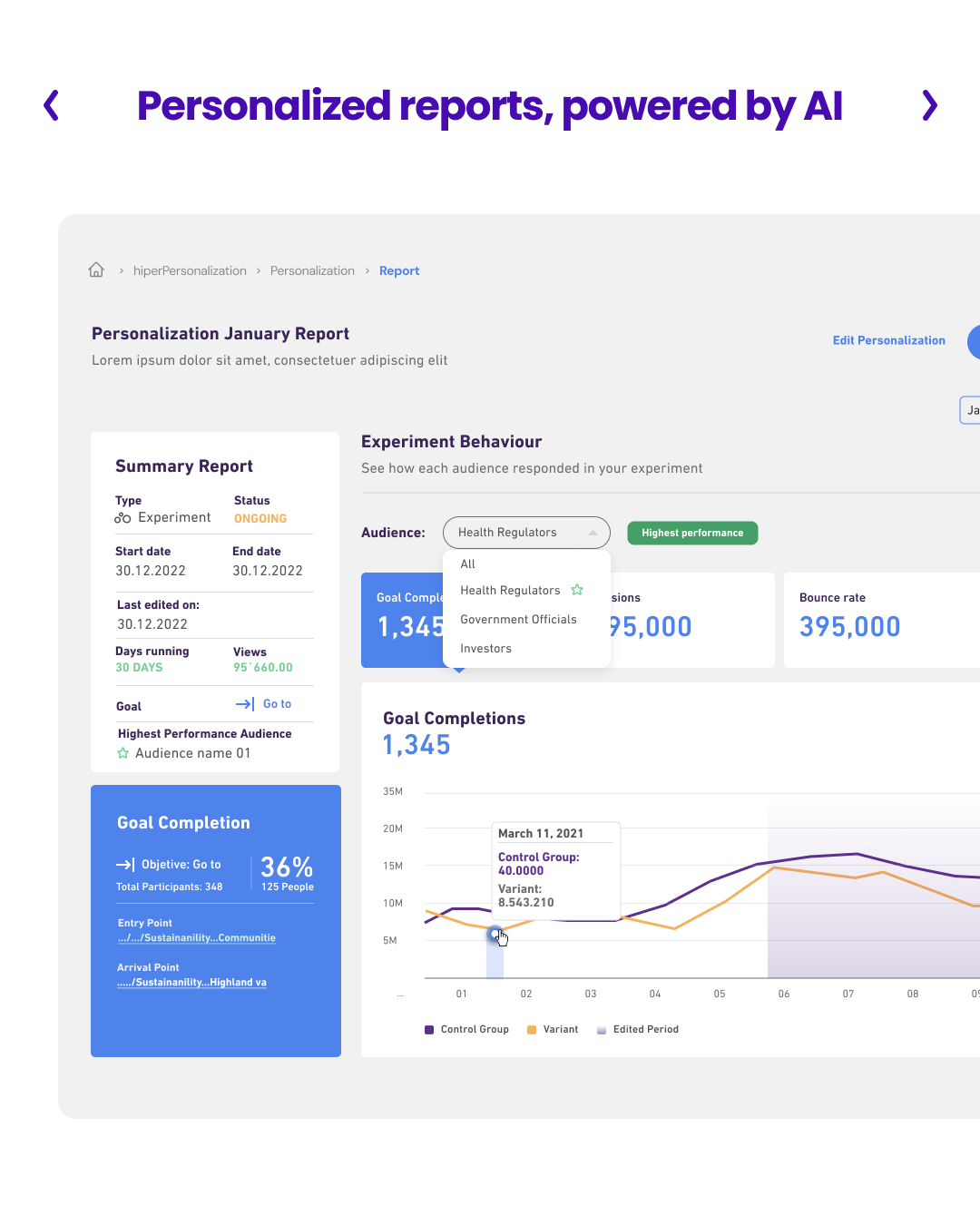
- Run experiments to compare personalized experiences against each other and measure actual performance, not just assume the personalization is working
The lessons from that implementation informed a more flexible product experience that Expresia could extend to other clients.
What makes this different from manually changing content:
Without this system, teams would have to manually create different versions of the same page for each audience. hyperPersonalization makes that process automatic by showing the right content to the right audience, while still letting teams step in and make changes when needed. This was important because teams need to feel in control, especially when they’re not ready to fully trust an algorithm with their content strategy.
The core usability challenge
The challenge was that the system had a lot of necessary complexity : audiences, tags, playlists, rules, and experiments. If these pieces felt disconnected, users would see them as five different tools instead of one product.
Working closely with UX, we focused on making these pieces feel connected and easy to understand. We looked at where users needed more context, where information could be simplified, and where AI needed to show what it was doing and let users make changes instead of feeling like a black box.
Designing for a Real-World Implementation
Teck was the first major environment where we tested the platform in a real-world setting. Its website served different audience groups with very different information needs, and the implementation eventually supported eight distinct audience segments.
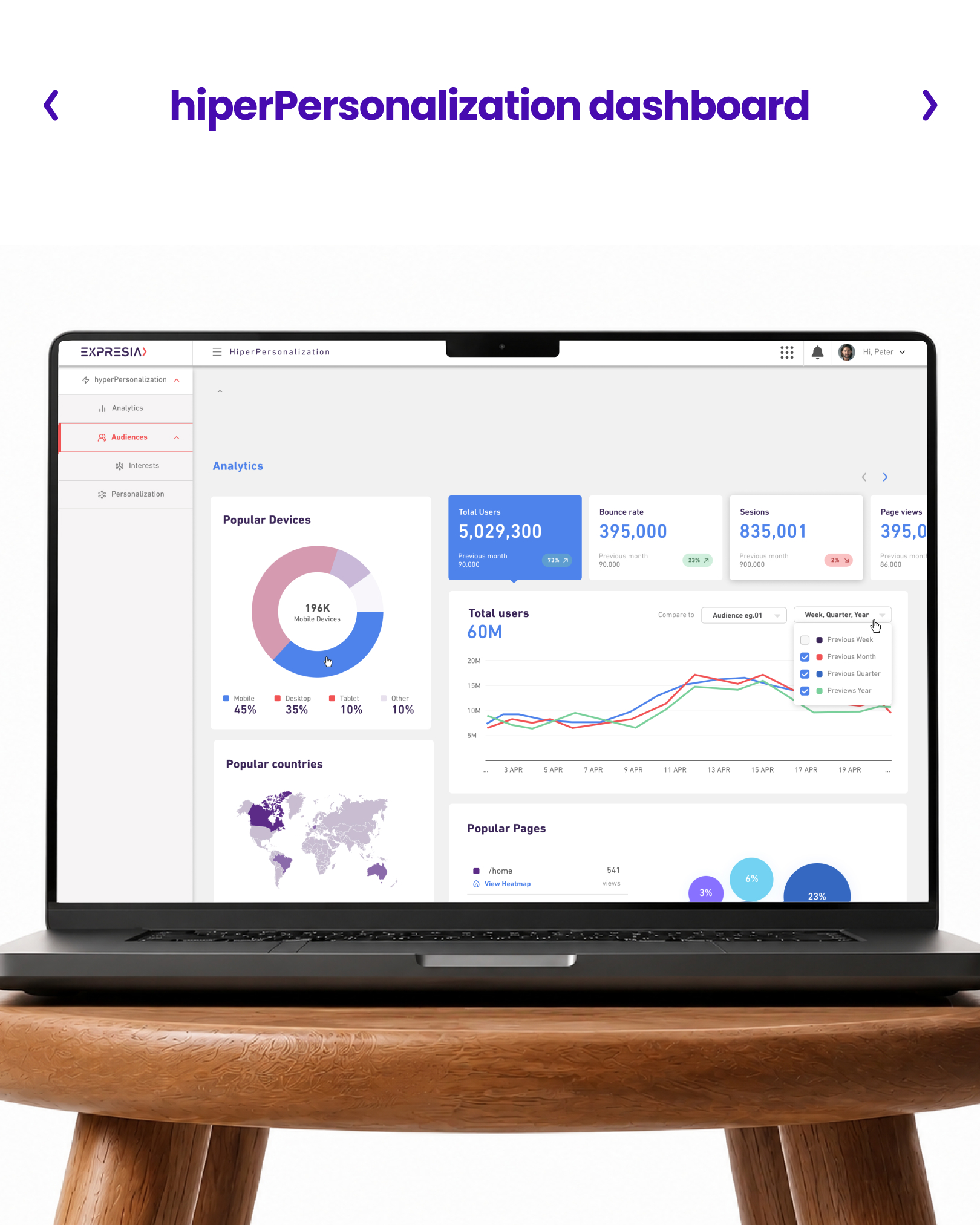
This gave us a chance to test key parts of the platform, including audience analytics, comparisons, interest reports, recommendations, and personalized content delivery.
Working with a live enterprise use case also showed us where users needed more context, where complex data needed to be simplified, and where AI needed to work alongside human control. These learnings helped shape Expresia into a more flexible product that could work for future clients.
Project Solutions
The final product connected several previously separate activities into one workflow.
Our process focused on:
- Audience Intelligence — helped teams understand audience behavior, interests, content consumption, and interaction patterns
- Behavioral Analytics — made it possible to explore how different groups navigated and interacted with digital experiences
- AI Recommendations — connected audience interests with relevant content automatically
- Smart Playlists — allowed personalized content collections to respond dynamically to audience behavior
- Editorial Controls — gave content teams the ability to pin, reorder, schedule, and manage content rather than relying entirely on automation
- Experiments — created a foundation for comparing experiences and measuring the effectiveness of personalization strategies
As lead designer, working alongside UX, my focus was ensuring these capabilities felt like parts of one coherent product rather than disconnected technical features stitched together.
Outcomes
The result was a reusable personalization platform that connects behavioral data with content decisions.
For content and marketing teams, the product created a clear path from understanding audience behavior to delivering and testing personalized experiences without needing to understand what's happening underneath.
For Expresia, the project established a product foundation built to extend beyond a single implementation. The platform architecture and interface patterns were designed to support different audience structures, content strategies, and client needs from day one.
The Teck implementation proved the core personalization workflow could hold up in a genuinely complex enterprise environment — supporting audience segmentation, analytics, AI recommendations, personalized delivery, and experimentation all within the same system.
Project Impact
8 Audience Segments
Eight distinct audience groups were identified and supported through the personalization system, allowing content to respond to different interests and behaviours.
3 Connected Pillars
The system connected Analytics, Audiences, and Personalization & Experiments to turn behavioural data into more relevant content experiences.
AI + Human Control
The platform combined automated recommendations with editorial tools for pinning, ordering, scheduling, and testing content—giving teams control over how personalization was applied.
Designed Beyond a Single Client
The experience was structured around reusable workflows and interface patterns, allowing Expresia to offer HyperPersonalization as a product capability for other clients rather than as a one-off Teck solution.


Related Work



Let’s Talk